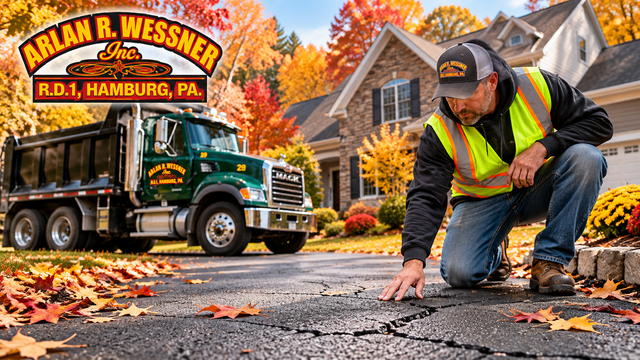
Quick Answer
Yes. Fall is a good time to check your driveway before freezing temperatures arrive. Small cracks, potholes, drainage problems, crumbling edges, and low spots can all get worse when water freezes and expands.
Taking care of problems now can help you avoid a bigger repair later.
October is one of those months when the weather starts giving you a warning.
Cold mornings. More rain. Leaves collecting along the edges of the driveway. And before long, freezing temperatures.
At Arlan R. Wessner, Inc., we work with homeowners, businesses, farms, and property owners throughout the region, and fall is a good time to take a closer look at your asphalt before winter puts it to the test.
1. Are There Cracks Starting to Spread?
A small crack may not look like much.
But once water gets inside and temperatures drop below freezing, that water can expand and put more pressure on the surrounding pavement.
That is one reason driveway cracks can grow over the winter.
Look for cracks that are getting wider, branching out, or showing up in several areas.
2. Are Potholes Starting to Form?
Potholes usually do not appear overnight.
They often start as a weaker area, a crack, or a spot where water has been getting underneath the pavement.
Once the surface starts breaking apart, traffic and freezing weather can make the problem worse.
A small repair in the fall may be easier to manage than a much larger damaged area in the spring.
3. Is Water Sitting on the Driveway?
Standing water is something to pay attention to.
After a rain, walk outside and look for puddles that stay in one place.
Low spots, poor grading, or drainage issues can allow water to sit on the pavement instead of moving away.
That water may eventually work its way into cracks or along the edges of the driveway.
At Arlan R. Wessner, we look at grading and drainage as part of the paving process because the surface itself is only one part of the job.
4. Are the Edges Crumbling?
The edges of a driveway can take a lot of stress.
Vehicles may drive close to them. Soil may wash away. Water can collect along the sides. Over time, those areas can begin to crack or break apart.
Walk the perimeter of your driveway and look for:
- Crumbling asphalt
- Broken edges
- Areas where the ground has washed away
- Cracks forming along the sides
Addressing the edge problem may help prevent the damage from spreading farther into the driveway.
5. Is the Surface Worn Beyond a Simple Repair?
Sometimes a driveway has moved beyond a few small cracks.
You may see widespread cracking, uneven areas, deep potholes, or sections that have started breaking apart.
That is when it may be time to ask whether patching still makes sense.
Depending on the condition of the pavement and the base underneath it, resurfacing or replacement may be the better long-term option.
The right answer depends on what is happening below the surface, not just what you can see from the driveway.
Should You Wait Until Spring?
Not always.
Some asphalt work depends on weather conditions, but waiting can also allow a small problem to become larger through repeated freezing and thawing.
Fall gives you a chance to look at the condition of the driveway, understand what is happening, and decide whether a repair should be handled now or planned for later.
At Arlan R. Wessner, Inc., we provide paving, repairs, grading, and related services for residential, commercial, agricultural, and municipal properties.
Should your driveway be showing signs of wear, fall is a good time to take a closer look before winter has a chance to make the problem worse.