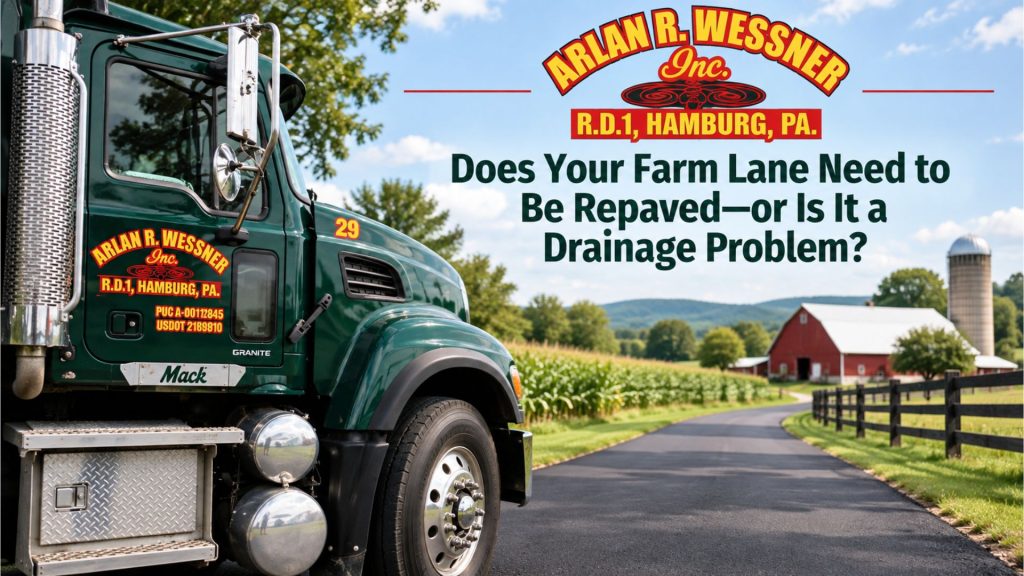
A farm lane takes a beating. Tractors, delivery trucks, trailers, weather, runoff, and daily traffic all put pressure on the surface. Then one day you notice the potholes are getting deeper, the edges are breaking apart, or the same low spot fills with water every time it rains.
The first thought may be, “We need to pave this.”
Maybe you do. But sometimes the bigger issue is underneath the pavement.
Quick Answer: Does My Farm Lane Need Paving or Better Drainage?
When a farm lane repeatedly develops potholes, standing water, ruts, or broken pavement in the same places, drainage or grading may be contributing to the problem. Before paving, it’s important to look at how water moves across the property, the condition of the base, and the type of equipment using the lane.
At Arlan R. Wessner, Inc., we evaluate those factors before recommending the right approach.
Why Does Water Cause So Much Damage to Farm Lanes?
Water finds the weak spots. When rainwater sits on pavement or works underneath it, the base can begin to weaken. Add heavy farm machinery traveling over that area, and the surface may eventually crack, sink, or develop potholes.
Pennsylvania weather adds another challenge.
Water can enter cracks, freeze during colder weather, expand, and make existing damage worse.
That’s why repairing the surface without correcting a drainage problem can sometimes mean dealing with the same damage again later.
How Do I Know If Drainage Is the Real Problem?
Look at what happens after a hard rain. Do you see water collecting in the same areas? Is runoff crossing the lane instead of moving away from it? Are certain sections always softer, muddier, or more damaged?
Those are clues worth paying attention to.
At Arlan R. Wessner, Inc., project planning includes looking at grading and drainage before determining the correct asphalt application for the job. That matters on farms because every property is different.
A lane in Lehigh County that handles tractors and grain trucks may need a different approach than a residential driveway carrying two passenger vehicles.
Can Heavy Farm Equipment Damage Asphalt?
Absolutely. Farm roads and lanes routinely carry equipment that weighs far more than the typical car or pickup truck.
That repeated weight can accelerate wear when the pavement, base, or drainage system isn’t designed for the traffic using it.
Our farm paving services are designed for agricultural properties where equipment needs dependable access to barns, fields, pole buildings, storage areas, and other parts of the farm.
The goal isn’t simply to make the lane look smooth.
It needs to work.
Should I Repair Potholes or Repave the Entire Lane?
It depends on the condition of the pavement. One or two isolated areas may be good candidates for repair.
A lane with widespread cracking, repeated potholes, sinking sections, or extensive surface wear may need more substantial work.
We look at the condition of the existing pavement, the base, drainage, traffic, and how the property is used before recommending a solution.
Sometimes the right answer is a repair. Sometimes it’s resurfacing. Sometimes starting over and rebuilding the base makes more sense.
What Should Be Checked Before Farm Paving Begins?
Before paving, ask these questions:
- Where does rainwater go?
- Are there low areas where water collects?
- What types of trucks and equipment use the lane?
- How frequently is the lane used?
- Are there potholes or cracks that keep returning?
- Does grading need to be corrected first?
Taking time to answer those questions can help prevent problems after the paving work is complete.
Can One Contractor Handle the Paving and Excavation?
That can make a farm project much easier.
Arlan R. Wessner, Inc. provides farm paving along with grading, drainage excavation, stone work, hauling, and other excavation services.
That means we can look beyond the asphalt when the property needs additional site preparation.
Our family-owned company has been serving the region for more than 50 years, working throughout Berks, Lehigh, Lebanon, Schuylkill, Reading, Allentown, Harrisburg, and surrounding Pennsylvania communities.
When Is the Best Time to Plan Farm Paving?
Start the conversation before the lane becomes difficult to use.
Paving work is weather dependent, so planning ahead gives you more flexibility around farm schedules, deliveries, planting, harvesting, and other busy times.
It also gives us time to walk the property with you and understand how the lane is actually used.
Our foreman reviews the site, including grading and drainage concerns, before a proposal is prepared.
Ready to Take a Look at That Farm Lane?
A rough farm lane is more than an appearance problem.
It can slow equipment, make deliveries harder, hold water, and become increasingly expensive to maintain.
Should you have a farm lane, agricultural driveway, or access road in Lehigh County or the surrounding region that’s showing its age, let’s take a look at what’s really causing the problem.
Sometimes the answer is fresh pavement.
Sometimes it starts with getting the water where it belongs.
Frequently Asked Questions
Does Arlan R. Wessner provide farm paving in Lehigh County?
We provide agricultural paving services throughout Berks and Lehigh Counties and other parts of eastern and central Pennsylvania.
Can you pave farm lanes used by heavy equipment?
We can do that for you. Farm paving projects can be planned around the type of tractors, trucks, trailers, and other equipment that regularly use the property.
Can drainage problems damage a paved farm lane?
Yes. Poor drainage can weaken the pavement and the base beneath it, contributing to cracks, potholes, sinking areas, and recurring damage.
Does drainage need to be fixed before paving?
When drainage or grading is contributing to pavement failure, it should be addressed as part of the project planning process.
Does Arlan R. Wessner also provide excavation?
Yes. Services include grading, drainage excavation, agricultural excavation, stone work, hauling, and other site preparation work.
How do I get an estimate?
Contact Arlan R. Wessner, Inc. to describe the project and schedule a site visit so the paving, grading, drainage, and other needs can be evaluated.