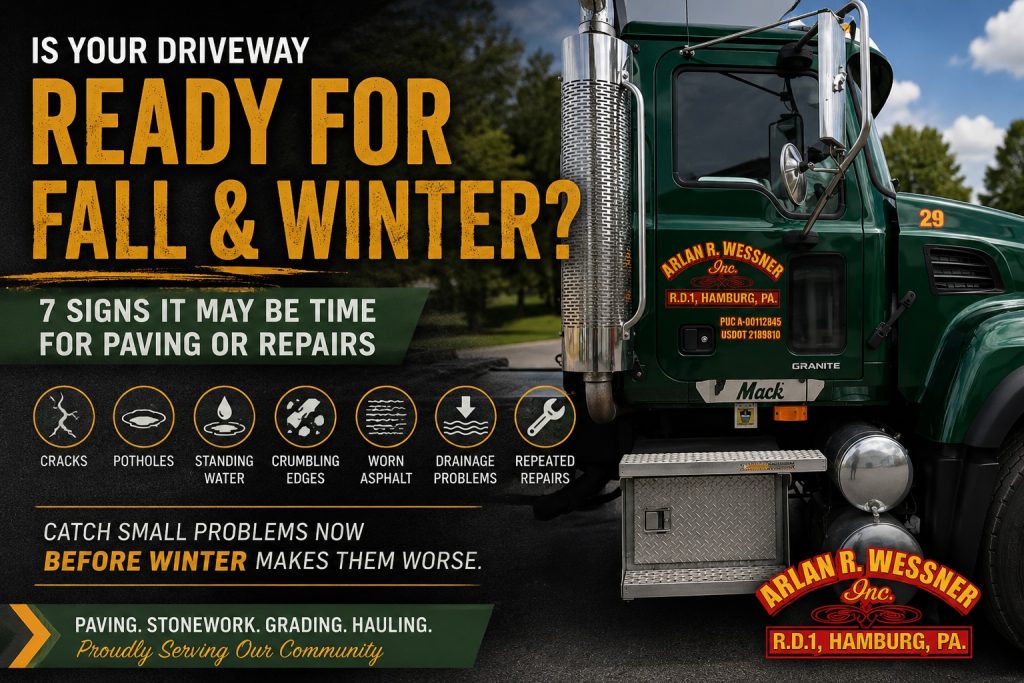
Quick Answer: Late summer and early fall are smart times to take a close look at your driveway, parking area, or paved surface. Cracks, potholes, standing water, crumbling edges, and worn asphalt can all become worse once freezing temperatures, snow, and ice arrive. Taking care of problems now can help protect the surface and reduce the chance of larger repairs later.
Your driveway may not be the first thing you think about when preparing for fall.
But after a summer of heat, rain, traffic, and everyday wear, this is a good time to take a closer look.
Maybe you’ve noticed a few cracks.
Maybe a low spot keeps holding water after it rains.
Maybe the edges are starting to break apart.
Or maybe the surface just looks tired and worn.
At Arlan R. Wessner, Inc., we work with homeowners, businesses, and property owners throughout the region on paving, stonework, grading, excavation, and related site work. One thing we see again and again is that small paving problems are much easier to deal with before winter has a chance to make them worse.
Here are seven signs it may be time to have your driveway or paved surface evaluated.
1. Cracks Are Starting to Spread
A small crack may not seem like a big deal.
But cracks give water a place to enter the pavement.
Once temperatures drop, that moisture can freeze, expand, and put additional pressure on the surrounding asphalt.
Over time, a small crack can become a much larger problem.
Not every crack means the entire driveway needs to be replaced. In some cases, repair may be enough. In others, widespread cracking can be a sign that the surface is reaching the end of its useful life.
The key is catching it before the damage spreads.
2. Potholes Are Beginning to Form
Potholes usually start with a combination of water, weakened pavement, and traffic.
Once the surface breaks apart, the problem often continues growing.
A pothole isn’t just unattractive. It can also create problems for vehicles, snowplows, pedestrians, and drainage.
For businesses and commercial properties, potholes can also make a poor first impression.
Should you already have potholes forming, it’s worth having them looked at before winter weather adds another season of freeze-and-thaw cycles.
3. Water Sits on the Surface After It Rains
Standing water is one of the biggest warning signs to pay attention to.
A properly prepared paved surface should help move water away rather than allowing it to collect in the same places.
Pooling water may point to:
Low spots
Poor grading
Drainage problems
Settling
Surface deterioration
Water can weaken pavement over time, especially when it repeatedly finds its way into cracks and small openings.
Sometimes the problem is the pavement itself.
Other times, the solution may involve grading, drainage improvements, or stonework around the area.
That’s why it helps to look at the property as a whole instead of simply covering over the visible problem.
4. The Edges Are Crumbling
Driveway edges often show wear before the center of the pavement does.
You may notice pieces breaking off, cracks developing along the sides, or areas where the asphalt no longer has good support.
This can happen when the base underneath begins shifting or when vehicles repeatedly drive too close to unsupported edges.
Crumbling edges usually don’t improve on their own.
Addressing them early can help prevent the damaged area from continuing to work its way inward.
5. The Surface Looks Worn, Faded, or Uneven
Not every paving problem starts with a pothole.
Sometimes the surface simply begins looking tired.
You may notice rough areas, worn patches, uneven texture, or places where the aggregate is becoming more visible.
That kind of wear can be a sign that the pavement has been exposed to years of sunlight, weather, traffic, and moisture.
Depending on the overall condition, the right solution might be repair, resurfacing, or replacement.
An experienced paving contractor can help determine which option makes the most sense.
6. You Keep Repairing the Same Areas
Are you filling the same crack or patching the same section year after year?
That can be a sign that there’s a deeper issue underneath.
Sometimes repeated surface repairs are only treating the symptom.
Problems with the base, drainage, grading, or settling may continue causing damage no matter how many times the top layer is patched.
At some point, continuing to repair the same spot may cost more than correcting the underlying problem properly.
7. Your Driveway Is Creating Drainage Problems Around the Property
A driveway affects more than where you park.
It can also influence how water moves across your property.
Poor grading may direct water toward:
- Garages
- Foundations
- Walkways
- Landscaping
- Low areas of the yard
That can create bigger problems than a worn driveway.
This is where paving, grading, excavation, and stonework often work together.
A good solution should improve both the surface and the way water moves around the property.
Why Fall and Winter Can Make Existing Problems Worse
Pennsylvania weather can be hard on paved surfaces.
When water enters cracks and temperatures fall below freezing, the water expands.
As temperatures rise again, it thaws.
That freeze-and-thaw process can happen many times over the course of a winter.
Each cycle can place more pressure on already damaged pavement.
Snow removal can also be harder on surfaces with potholes, broken edges, or uneven areas.
That’s why late summer and early fall are such useful times to evaluate the condition of your driveway.
You still have time to identify concerns before winter weather arrives.
Repair, Resurface, or Replace?
This is one of the most common questions property owners have.
And the answer depends on the condition of the pavement.
Repair May Be Enough When:
Damage is limited to a few isolated areas.
Small cracks, potholes, or localized failures may be able to be repaired without replacing the entire surface.
Resurfacing May Make Sense When:
The pavement is worn but the underlying base is still in good condition.
A new surface layer can improve appearance and extend the useful life of the paved area.
Replacement May Be the Better Choice When:
There is widespread cracking, major settling, repeated potholes, significant drainage issues, or failure of the underlying base.
In those situations, continuing to patch the surface may only delay a larger project.
The best approach is to evaluate the entire paved area before deciding.
Don’t Forget About the Base
What you see on top is only part of the story.
A long-lasting paving project starts underneath the asphalt.
The base needs to be properly prepared, graded, and compacted.
Poor base preparation can lead to:
- Settling
- Cracking
- Low spots
- Drainage problems
- Premature pavement failure
That’s why excavation and grading are such important parts of paving work.
A good-looking surface won’t last if the foundation underneath it isn’t solid.
Stonework Can Be Part of the Solution Too
Not every property needs asphalt everywhere.
Stone can be an excellent choice for certain driveways, access areas, parking areas, farm lanes, drainage applications, or site preparation.
The right stone and proper placement can provide a durable surface while helping with drainage and access.
In some cases, a combination of paving and stonework may be the most practical solution for the property.
A Simple Driveway Check Before Fall
Take five minutes and walk the length of your driveway or paved area.
Look for:
- New or widening cracks
- Potholes
- Standing water
- Crumbling edges
- Uneven areas
- Low spots
- Areas that have been patched repeatedly
- Drainage problems
- Sections that look noticeably more worn than last year
Should you see one or more of these signs, it doesn’t automatically mean you need a new driveway.
It simply means the surface deserves a closer look.
A Good Paving Project Starts With the Right Plan
At Arlan R. Wessner, Inc., we believe good paving work starts long before the asphalt goes down.
The condition of the existing surface, the base underneath it, drainage, grading, traffic, and how the property is used all matter.
That’s why every property needs to be evaluated on its own.
A residential driveway has different needs than a commercial parking area.
A farm lane has different needs than a municipal road.
And a property with drainage problems may need more than a surface repair.
The goal is to create a solution that works for the property—not just make it look better for a season.
Is Your Driveway Ready for Winter?
Late summer and early fall are good times to find out.
A few cracks or worn areas may not be urgent.
But should the pavement be showing multiple signs of wear, drainage problems, potholes, or repeated failures, addressing those concerns before winter can help prevent them from becoming bigger.
At Arlan R. Wessner, Inc., we provide paving, stonework, grading, excavation, hauling, and related site services for residential, commercial, agricultural, and municipal needs.
Should you be wondering whether your driveway needs repair, resurfacing, replacement, or simply an experienced opinion, we’d be glad to take a look and help you understand your options.
Frequently Asked Questions
Should I repair driveway cracks before winter?
Yes. Cracks can allow water to enter the pavement. During freezing weather, that moisture can expand and contribute to additional damage.
What causes potholes?
Potholes commonly develop when water reaches weakened areas beneath the pavement and traffic continues stressing the surface. Freeze-and-thaw cycles can make the damage worse.
Does standing water mean my driveway has a drainage problem?
It can. Standing water may indicate low spots, settling, poor grading, or drainage issues that should be evaluated.
Can a damaged driveway be resurfaced instead of replaced?
Sometimes. Resurfacing may be an option when the base is still in good condition and the damage is mainly at the surface. More extensive failure may require replacement.
Why is grading important before paving?
Proper grading helps create a stable base and directs water away from areas where it can cause damage. Good preparation is essential for a long-lasting paved surface.
Does Arlan R. Wessner, Inc. only install asphalt?
No. In addition to paving, Arlan R. Wessner, Inc. provides stonework, grading, excavation, hauling, and related site services.
When should I have my driveway inspected?
Any time you notice spreading cracks, potholes, standing water, crumbling edges, settling, or repeated repairs, it’s worth having the area evaluated.
Ready to Take a Closer Look?
You don’t have to wait until a pothole becomes a major problem.
A quick evaluation now can help you understand what your driveway needs and whether a repair, resurfacing, paving, grading, or stone solution makes the most sense.
A little attention before winter can make a big difference when spring arrives.